Forestry & Wildlife
Why is this study being done?
Sugar maple dominated northern hardwood forests cover more than five million acres of Michigan. These trees are a critical sources of forest products, wildlife habitat, recreation and clean water.
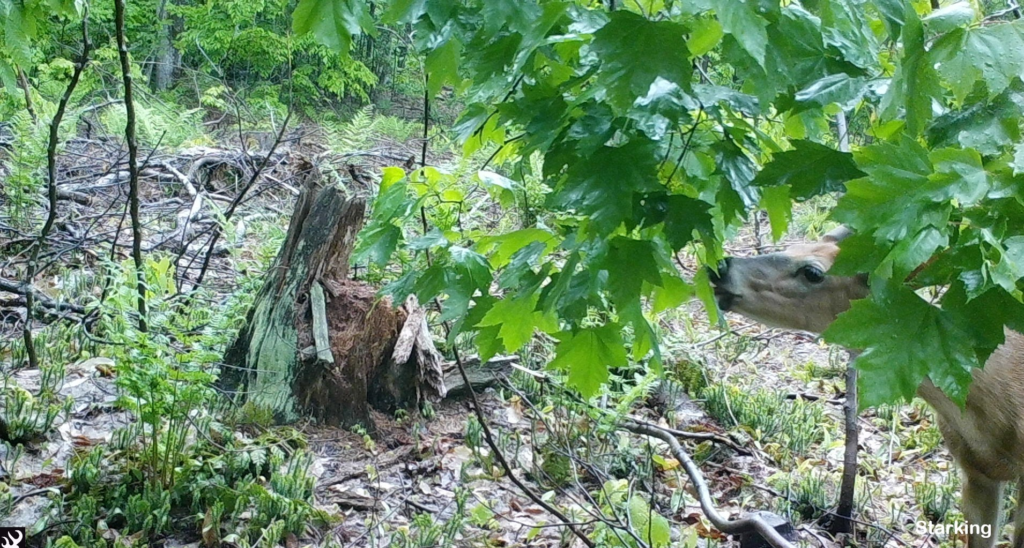
Measures of successful management is tree regeneration, or new seedlings filling the spaces left by harvested trees, and tree recruitment, or getting trees tall enough that they have a good chance of recruiting into the overstory canopy. One or both of these is not occurring, which threatens sustainability. The causes are many and often intertwined. They include past forest management, impacts of deer browsing, insect and disease outbreaks, and climate change, among others.
The study
Michigan State University, Michigan Department of Natural Resources, and forest industry are addressing this problem with a project aimed at identifying silvicultural techniques for overcoming challenges to tree regeneration and recruitment. Ultimately, use of these new techniques is expected to improve sustainability, resilience, and diversity of forests while supporting sufficient deer populations for satisfactory hunting opportunities.
Single-tree selection silviculture has been the dominant management practice in northern hardwood forests for decades. In this system, dispersed, individual trees are periodically harvested (every 10-15 years). Researchers are comparing this system to: 1) group selection, in which groups of trees are removed, making larger harvest gaps for regenerating trees; 2) shelterwood, in which 50% of trees are harvested with remaining trees providing seed and shelter for tree regeneration; and 3) seed tree, where 6 to 8 trees per acre are left to provide seed for regeneration.
Researchers are also testing two understory treatments: 1) leaving treetops to discourage deer browsing of tree regeneration; and 2) reducing competing vegetation and scarifying the forest floor to improve conditions for tree seed germination.
MSU researchers are monitoring the effects of treatments on tree regeneration, deer, and other wildlife for 10 years.
Desired Outcomes
Following monitoring and analysis, researchers will identify the treatment(s) resulting in desired tree regeneration by locality and region (there are 140 sites throughout the state). Forest managers will use this information to improve sustainability and diversity of our northern hardwood forests.
Featured Highlights
01
Research Insights
Explore the groundbreaking findings from our extensive research on northern hardwoods, showcasing innovative methodologies and impactful results that contribute to ecological understanding.
02
Collaborative Efforts
Discover the partnerships that drive our research forward, highlighting the contributions of various stakeholders and the collaborative spirit that fuels our project’s success.
03
Innovative Approaches
Learn about the cutting-edge techniques employed in our research, designed to enhance data collection and analysis, ensuring robust and reliable outcomes for future studies.
04
Community Engagement
Engage with our outreach initiatives aimed at educating the public and fostering community involvement in research activities, promoting awareness and appreciation for northern hardwood ecosystems.
05
Future Directions
Understand the future trajectory of our research, including upcoming projects and potential areas of exploration that will further advance knowledge in the field of northern hardwoods.
06
Key Findings
Uncover the essential discoveries made throughout our research, providing valuable insights into the dynamics of northern hardwood ecosystems and their significance in broader ecological contexts.